How to Solve Bridges Puzzles
How the Bridges puzzle works and how to solve it by logic: full islands, lonely neighbours, the isolation rule, crossings and joining every island.
Bridges is a sea of numbered islands. Each number tells you how many bridges must touch that island. You build bridges straight across or straight down to the nearest island in that direction, one or two between the same pair, and no bridge may cross another or pass over an island. The puzzle is solved when every island has exactly its number and all of the islands are joined into a single group, so that you could walk from any island to any other. Every daily sea is checked by a solver before it is published and has exactly one solution, which means you never have to guess: there is always a next bridge you can prove.
How to play on the site
Tap an island and then a neighbour in the same row or column to build a bridge between them, or drag from one island to the other. Doing the same again turns it into a double bridge, and a third time takes it away. You can also tap a bridge itself to change it. An island turns green when it has exactly its number of bridges and red when it has too many, and the counter above the board shows how many islands are done. Undo takes back your last change, and Start over clears the sea. With a keyboard, the arrow keys move between islands, Enter picks one, and an arrow key then builds a bridge in that direction.
Two options help while you learn. "Show where bridges can go" draws dotted lines from the island you picked to every island it can reach, which makes the neighbours easy to see on a crowded board. "Show the bridges still needed" replaces each number with the count that is still missing, so the map counts down to zero as you work.
Start with islands that have no choice
The fastest way into any sea is to find islands whose number leaves no freedom. An island can have at most four neighbours, one in each direction, and at most two bridges to each, so its largest possible number is twice its count of neighbours. When the number equals that maximum, every possible bridge is a double:
- An 8 in open water takes double bridges in all four directions.
- A 6 with only three neighbours takes three doubles.
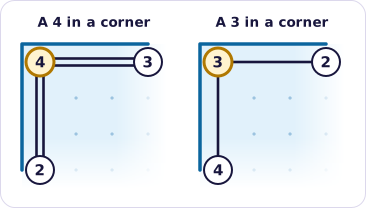
- A 4 in a corner, with two neighbours, takes two doubles.
- A 2 with a single neighbour takes a double to it.
Next come the numbers that are one below the maximum. A 7 with four neighbours, a 5 with three or a 3 with two must have at least one bridge to every neighbour, because even with doubles everywhere else it could not reach its number without each of them. Build those single bridges straight away; they often decide a whole corner.
Lonely neighbours and the edge of the map
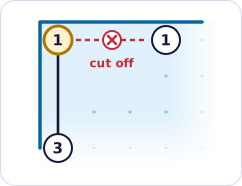
An island near the edge, or one boxed in by bridges you have already built, may have only one neighbour left that it can still reach. Every bridge it still needs must go there. This is worth checking after every few moves: each bridge you build blocks the cells it crosses, so islands on the far side of it lose a neighbour and their choices shrink. Many puzzles unfold as a chain, where one forced bridge cuts off a neighbour, which forces another bridge, which cuts off the next.
The same idea works when a neighbour is already full. An island that has all of its bridges can take no more, so it no longer counts as a neighbour for anyone else. Treat full islands as if they were rocks.
The isolation rule
Because every island must end up in one connected group, some bridges are impossible even when the numbers allow them:
- Two 1s side by side can never be joined to each other. If they were, both would be full and the pair would be cut off from the rest of the sea.
- Two 2s can be joined by a single bridge, but never by a double, for the same reason.
- More generally, never complete a small group of islands that are all full unless that group is every island on the board.
This rule often settles a choice between two neighbours. A 1 that can reach another 1 and a 3 must link to the 3. A 2 next to another 2 and a 4, with no other neighbours, must give at least one bridge to the 4.
Advertisement
Bridges that cross
A bridge that runs across blocks every bridge that would run down through the same cells, and the other way round. When two islands could link across a channel that another pair could link down, decide which pair needs its bridge more. If one of them has no other way to reach its number, its bridge wins, and the crossing pair is impossible. Remember too that a bridge you have built removes neighbours: an island that could see an island three cells away loses it once a bridge runs between them.
Joining every island
Near the end, you may find every number satisfied but the islands split into two or more groups. The site tells you when that happens. It means a choice somewhere was wrong: look for a double that could be two singles to different islands, or a pair of islands whose bridges could be redirected through a neighbour to link the groups. Because the solution is unique, the true layout always joins everything, and the isolation rule above is the best guard against reaching this point at all.
Difficulty, scoring and the leaderboard
| Level | Sea | Islands |
|---|---|---|
| Easy | 7 × 7 | about 11 |
| Medium | 9 × 9 | about 18 |
| Hard | 11 × 11 | about 27 |
Bridges is ranked by time, fastest first; fewer bridge changes break ties. Every tap that adds or removes a bridge counts as a change, including the ones you undo, so a careful solver who builds only what is proven gets the best tiebreak. Only a member's first solve of the day counts for the leaderboard, and practice seas are never ranked.
A short routine for every sea
- Mark every island whose number equals twice its neighbours, and build its doubles.
- Build a single bridge to every neighbour of each island that is one below its maximum.
- Look for islands with only one reachable neighbour, and remember that full islands and existing bridges remove neighbours.
- Apply the isolation rule to every pair of 1s and every pair of 2s.
- Repeat until the sea is done, checking that everything is joined into one group.
Play it now
Every game is free in your browser, with nothing to download; the daily puzzles change at midnight and the archive keeps the last 60 days. See all the logic games.
Questions and answers
Does every Bridges puzzle have one answer?
Yes. Each daily sea is checked by a solver, and only seas with exactly one solution are used, so every bridge can be worked out by logic.
Can bridges bend or run diagonally?
No. A bridge is a straight line across or down between two islands in the same row or column, with nothing but sea between them.
Why can’t I join two 1s?
Both islands would be full with nothing else attached, so they could never be joined to the rest of the sea. A bridge between two 1s is never part of the solution.
What counts as a change?
Every tap or drag that adds or removes a bridge. Changes break ties between players with the same time.
How is it ranked?
By time, fastest first; fewer changes break ties. Only a member’s first solve of the day is ranked.
Written by the DailyGameClub team from the rules as DailyGameClub plays them. Updated October 26, 2026. New to a word? See the glossary. Spotted a mistake? Tell us.