






























About Arrows
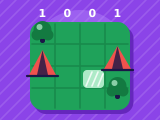
Arrows fills a board with bent arrows, packed so tightly that most of them are boxed in. Tap one and it slides forward along its own path, like a little train, and leaves the board, but only if every square ahead of its head is empty to the edge. The trick is the order: free the arrows that can go, and the ones behind them open up.
How to play Arrows
- Tap an arrow: it slides forward the way its head points, its body following its own bends, and leaves the board.
- An arrow can only leave if nothing is in the squares ahead of its head, all the way to the edge. If something is, it bumps into it and slides back: that is a mistake.
- Clear every arrow from the board. Easy is 8 × 10 squares, medium 11 × 14 and hard 14 × 18. Every board can be cleared.
- Fastest time wins; fewer mistakes break ties. A hint shows an arrow that can leave, and counts as a mistake.
Tips & strategy
- Start at the edges. An arrow pointing straight out of the board with nothing in front of it can always go.
- Look along the line ahead of an arrowhead, not at the body. Only the squares in front of the head matter.
- An arrow that leaves never blocks anything again, so clearing a free arrow is never a wrong move.
- When you are stuck, find the arrow that blocks the most others and work out what is in its own way.
- Hover or press an arrow to see the dotted way out ahead of it before you commit.
Arrows: questions and answers
Can every board be cleared?
Yes. Every board is checked by a solver when it is made, and taking an arrow away never blocks another, so any free arrow is a safe move.
What counts as a mistake?
Tapping an arrow whose way out is blocked. It bumps into the arrow in front and slides back. A hint also counts as one mistake.
How is Arrows ranked?
By time, fastest first. Players with the same time are ordered by fewer mistakes.
What changes with the difficulty?
The board grows from 8 × 10 squares on easy days to 11 × 14 on medium and 14 × 18 on hard days, with more and longer arrows in longer chains.