



































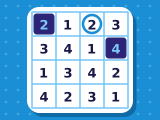









About Calcudoku
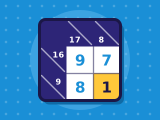
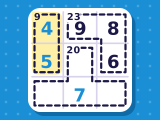
Calcudoku mixes the row-and-column logic of sudoku with a little mental arithmetic. The grid is cut into outlined cages, and each cage shows a target with a sign that its digits must make. Every row and column holds each digit once, so the sums and the placement rules work together: a 3− cage in a 4×4 grid can only be 1 and 4. Easy days are 4×4, medium days 5×5 and hard days 6×6.
How to play Calcudoku
- Fill every square with a digit from 1 up to the size of the grid: 1 to 4 on easy days, 1 to 5 on medium days and 1 to 6 on hard days. No digit may appear twice in a row or a column.
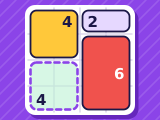
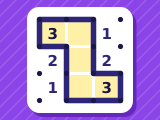
- The thick lines split the grid into cages. The number and sign in a cage’s corner say what its digits must make: added (+), multiplied (×), or for two squares the bigger minus the smaller (−) or the bigger divided by the smaller (÷).
- A digit may repeat inside a cage, as long as the two copies are in different rows and columns. A cage of one square is filled in for you.
- Select a square, then tap the number pad or type a digit. Notes mode adds small pencil marks. Fastest time wins; every grid has exactly one solution.
Tips & strategy
- Start with the cages that allow only one or two digit sets: a big product, a large difference or a tiny sum often pins them down at once.
- Write the possible digits in each cage as pencil notes, then cross out any that already appear in the same row or column.
- A row or column always adds up to the same total (10 on 4×4, 15 on 5×5, 21 on 6×6), so a row covered by whole cages and one loose square gives that square away.
- Remember that a digit can repeat inside a bent cage when the two squares are in different rows and columns.
Calcudoku: questions and answers
Can a digit repeat inside a cage?
Yes, if the two squares are in different rows and columns. The rule that no digit repeats applies only to rows and columns.
How is Calcudoku ranked?
By time, fastest first; fewer entries break ties. Only a member’s first solve of the day counts for the leaderboard.
Does every puzzle have one solution?
Yes. Each grid is solved by a computer when it is made, and only grids with exactly one answer are published.