How to Clear Daily Mines Without Guessing
How Daily Mines works and how to clear a mine field by logic: reading numbers, safe squares, flags, the 1-2 pattern, chords and counting the last mines.
Daily Mines is a grid of covered squares with mines hidden under some of them. Open a safe square and it shows a number: how many of its eight neighbours, across, up, down and on the diagonals, hide a mine. Your job is to open every safe square. Unlike the old desktop game it grew from, every daily field here can be cleared without a single guess. The board starts with an open area round a marked start square, and a solver has checked that the numbers you can see always lead to the next safe square, all the way to the end.
That changes how you play. There is never a fifty-fifty to gamble on: if you feel stuck, something on the board already tells you the answer, and this guide is about finding it.
Reading a number
A number counts mines among the covered neighbours of a square. Two things make it useful:
- Neighbours already open are safe, so they don't count.
- Neighbours you have flagged count toward the number.
So for every number, ask: how many mines does it still need, and how many covered, unflagged squares does it touch? Those two counts settle most of the board.
| Mines still needed | Covered squares | What it means |
|---|---|---|
| 0 | any | every covered neighbour is safe |
| same as the squares | 1 or more | every covered neighbour is a mine |
| fewer than the squares | 2 or more | undecided for now: look at its neighbours |
The first moves
Start at the edge of the open area, where numbers touch covered squares. Look for the easy ones:
- A 1 that touches a single covered square. That square is the mine. Flag it.
- A number whose mines are all flagged. Every other covered neighbour is safe. Open them.
- A number with exactly as many covered neighbours as it shows. All of them are mines.
Corners and walls help, because squares there have fewer neighbours. A 1 in a corner of the open area often touches just one covered square.
Flags and chords
A flag is a note to yourself; the game never checks it. Long press a square on a phone, right click it on a computer, or switch on Flag mode below the board so that taps place flags. Flags matter because they make numbers easy to finish: once a number has all its mines flagged, tap the number itself and every other covered square round it opens at once. This is called a chord, and it saves a lot of taps on the bigger fields.
A wrong flag makes a chord open a mine, so place flags only when you are sure. Opening a mine never ends the game here: it shows in red, counts as one mistake and you carry on, but mistakes break ties on the leaderboard.
Patterns worth knowing
When no single number decides anything, compare two numbers that share squares.
The 1-2 along a wall
Picture a row of open squares against a covered row, with a 1 next to a 2, and the 1 touching only two of the covered squares the 2 also touches. The 2 touches one more covered square, beyond the 1. The 1 says its two squares hold one mine; the 2 needs two mines from those same two squares plus one more. Only one mine can come from the shared pair, so the extra square must be the second mine. Flag it.
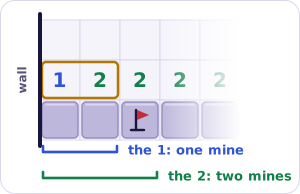
The general rule behind it: if one number's covered squares are all inside another's, the difference in their counts belongs to the squares only the bigger one touches.
- Same count: the extra squares are all safe.
- Count difference equal to the extra squares: the extra squares are all mines.
Two other shapes come up often:
- 1-1 from a wall. Two 1s side by side along an edge, the first touching two covered squares: the third covered square along from the first 1 is safe.
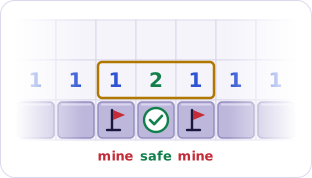
- 1-2-1. Along a straight edge, the squares under the two 1s are mines and the one under the 2 is safe.
Advertisement
Counting at the end
The counter above the board shows how many mines are left: the total minus your flags and any mines you opened by mistake. Near the end it settles the last squares:
- No mines left: every covered square is safe. Open them all.
- As many mines left as covered squares: they are all mines.
On hard fields it is worth glancing at the counter whenever you feel stuck in a closed corner. Two covered regions and one mine left often decide which region it is in.
Difficulty, scoring and the leaderboard
| Level | Field | Mines |
|---|---|---|
| Easy | 9 × 9 | 10 |
| Medium | 12 × 12 | 24 |
| Hard | 14 × 14 | 38 |
Daily Mines is ranked by time, fastest first; fewer mistakes break ties. Time starts with your first move, and only a member's first finished game of the day is ranked. Archive days and practice fields work the same way and are a good place to learn the patterns without the clock mattering.
Habits of fast players
- Sweep the edge of the open area in one direction. Going round the frontier once, in order, finds more than jumping about.
- Flag only what you will chord. On easy fields you can open safe squares without flagging at all; flags pay off where you will chord.
- Trust the board. Every field can be solved without guessing, so if two squares look equally likely, look further away: another number somewhere already decides them.
Play it now
Every game is free in your browser, with nothing to download; the daily puzzles change at midnight and the archive keeps the last 60 days. See all the logic games.
Questions and answers
Do I ever have to guess?
No. Every daily field is checked by a solver before it is used, and only fields that can be cleared from the start area by logic alone are kept.
What happens when I open a mine?
It shows in red and counts as a mistake, but the game goes on. Mistakes break ties between equal times on the leaderboard.
How do I flag a square on a phone?
Long press it, or switch on Flag mode below the board so that a tap flags instead of opening.
What is a chord?
Tapping an opened number whose mines are all flagged: every other covered square round it opens at once. You can switch it off in Options.
How is Daily Mines ranked?
By time, fastest first; fewer mistakes break ties. Only a member’s first finished game of the day is ranked.
Written by the DailyGameClub team from the rules as DailyGameClub plays them. Updated October 26, 2026. New to a word? See the glossary. Spotted a mistake? Tell us.