







About Light Up
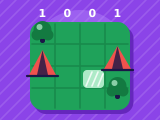
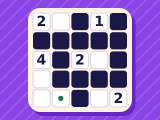
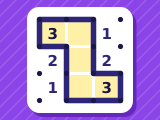
Light Up is a logic puzzle about lighting a dark room. The grid has white squares and black blocks, and you place lamps on the white squares. A lamp shines along its row and column until a block or the edge stops it, and by the end every white square has to be lit. Two lamps may never shine on each other. Some blocks carry a number from 0 to 4: exactly that many lamps stand on their four sides. Easy days are 7 × 7, medium 10 × 10 and hard 12 × 12, and every grid has one answer that you can reach by logic alone.
How to play Light Up
- Put lamps on white squares. A lamp lights its own square and every square in its row and column, until a black block stops the light.
- Every white square must be lit, and no lamp may shine on another lamp. A number on a block is how many lamps touch its four sides (corners don’t count); a block without a number can have any.
- Tap a square for a lamp, tap again for a dot (a note for a square that can’t hold a lamp) and once more to clear it. Drag across squares to paint dots.
- Easy grids are 7 × 7, medium 10 × 10 and hard 12 × 12. Every grid has one answer, found by logic alone. Fastest time wins; fewer changes break ties.
Tips & strategy
- Start with the 4s and the 0s. A 4 has a lamp on every side, and a 0 has none, so dot its sides at once.
- A 3 against the edge or another block has only three open sides, so all three are lamps. A 2 tucked into a corner works the same way.
- Look for a dark square that only one square can still light, often at the end of a short dead end. That square holds a lamp.
- The squares diagonal to a 3 never hold a lamp: whichever three sides the 3 uses, one of its lamps would shine on them.
Light Up: questions and answers
Do the blocks without a number matter?
Only as walls. They stop the light, and any number of lamps may stand beside them, including none.
Does a lamp diagonal to a number count?
No. A number only counts the lamps directly above, below, left and right of it. Diagonal lamps are allowed but are not counted.
How is Light Up ranked?
By time, fastest first; fewer changes break ties. Only a member’s first solve of the day counts for the leaderboard.