



















About Futoshiki
Futoshiki is a small, quick number puzzle from Japan whose name means “inequality”. Like sudoku, every row and column holds each digit once, but instead of boxes the grid has little signs between some squares, and the open side of each sign faces the bigger digit. A handful of signs is enough to fix the whole grid, so every square becomes a small chain of reasoning: if this one is smaller than that one, and that one is smaller than the next, the first must be low. Easy days are 4×4, medium 5×5 and hard 6×6, and every grid can be solved by logic alone.
How to play Futoshiki
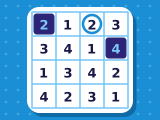
- Fill every square with a digit from 1 up to the size of the grid: 1 to 4 on easy days, 1 to 5 on medium days and 1 to 6 on hard days. No digit may appear twice in a row or a column.
- The signs between neighbouring squares must be true: the open side of < or > faces the bigger digit, and the same goes for the signs between rows (∧ means the upper digit is smaller, ∨ that it is bigger).
- A few digits may be given; they can’t be changed. Select a square, then tap the number pad or type a digit. Notes mode adds small pencil marks.
- Every grid has exactly one solution and can be solved by logic alone, without guessing. Fastest time wins; fewer entries break ties.
Tips & strategy
- Follow the chains: a square smaller than two others in a row of signs can only hold the lowest digits, and the top of a chain only the highest.
- The ends are the strongest clues. The largest digit can never sit on the small side of a sign, and 1 can never sit on the big side.
- Use notes for the squares with two or three candidates, then let the row and column rule cross them out as digits go in.
- When a row has one place left for a digit, it goes there, even if that square has no sign at all.
Futoshiki: questions and answers
How do I read the signs between rows?
The same way as across: the point of the sign faces the smaller digit. ∧ means the upper square is smaller, ∨ that it is bigger.
Do I ever need to guess?
No. Every daily grid is checked when it is made: the basic rules alone fill it in, which also proves it has one solution.
How is Futoshiki ranked?
By time, fastest first; fewer entries break ties. Only a member’s first solve of the day counts for the leaderboard.