How to Solve Futoshiki Puzzles
How Futoshiki works and how to solve it quickly: reading the signs, chains of inequalities, the highest and lowest digits, notes and row logic.
Futoshiki is a small square grid of digits with one familiar rule and one new one. The familiar rule is the sudoku rule: every row and every column holds each digit exactly once, from 1 up to the size of the grid. The new rule is in the gaps. Between some neighbouring squares there is a sign, and the sign must be true: the open side faces the bigger digit and the point faces the smaller one. The name is Japanese and means "inequality", and the signs are all the clues you get, apart from a digit or two that may be filled in from the start.
Reading the signs
Across a row the signs are the usual < and >. Read them left to right as you would in arithmetic: 2 < 4 says the left square is smaller. Between rows the same sign is turned on its side. ∧ means the upper square is smaller than the one below it, and ∨ means the upper square is bigger. A quick way to remember it: the point of a sign always touches the smaller digit, whichever way it faces.
| Sign | Where | Meaning |
|---|---|---|
| < | between two squares in a row | the left digit is smaller |
| > | between two squares in a row | the left digit is bigger |
| ∧ | between two rows | the upper digit is smaller |
| ∨ | between two rows | the upper digit is bigger |
Squares with no sign between them can hold any digits that the row and column allow. Most grids have only a dozen or so signs, which is the charm of the puzzle: a few small arrows decide everything.
Sizes and difficulty
| Level | Grid | Digits | Typical clues |
|---|---|---|---|
| Easy | 4 × 4 | 1 to 4 | two given digits and seven or more signs |
| Medium | 5 × 5 | 1 to 5 | one given digit and around ten signs |
| Hard | 6 × 6 | 1 to 6 | few or no digits and fifteen or so signs |
Every daily grid is made so that the basic rules alone solve it: placing a digit removes it from its row and column, a digit with one place left in a line goes there, and each sign trims the digits that are too big or too small on its two sides. You never need to guess, and that also proves the grid has exactly one answer.
The ends of the range
The quickest deductions come from the smallest and largest digits. A square on the big side of a sign can never hold 1, because nothing is smaller than 1. A square on the small side can never hold the largest digit. So in a 5 × 5 grid, a square that is bigger than both of its neighbours in the same row (a sign on each side) cannot be 1 or 2, because those two neighbours hold two different smaller digits; a square smaller than both of its row neighbours cannot be 4 or 5. The same goes for a square between two signs in a column.
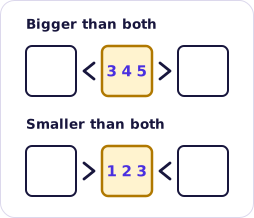
Turn this round and look for the places where a 1 or the top digit can still go. Every row needs a 1 and a 5 somewhere. If the signs rule the 1 out of four squares of a row, the fifth square is the 1, even if it has no sign of its own.
Follow the chains
Signs often line up: a < b < c across a row, or a ∧ under another ∧ down a column. A chain of length three in a 5 × 5 grid squeezes its squares hard. The first square is smaller than two others, so it is at most 3; the last is bigger than two others, so it is at least 3; the middle one sits between them, so it is 2, 3 or 4.
A chain of three
In a 4 × 4 grid the top row reads a < b < c with a fourth square d at the end and no sign before it. The chain needs three different rising digits from 1 to 4. If d is given as 4, the chain must be 1, 2 and 3 in that order, and the whole row is solved at once. If d is 1 instead, the chain is 2, 3 and 4.
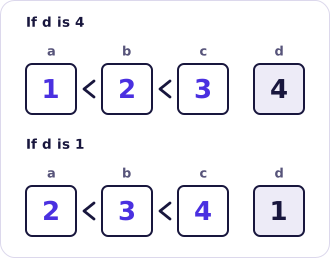
Chains also bend. A square that is smaller than its right neighbour and also smaller than the square below it behaves like the bottom of a little valley: it holds one of the smallest digits left in its row and column.
Advertisement
Notes and elimination
On medium and hard days most of the solving happens in the pencil marks. A routine that works well:
- Write the range of every signed square. Use the ends of the range and the chains to cut each square down, then switch on Notes and add the digits that are left.
- Clear what the rows and columns already hold. The page can do this for you: leave Notes clear themselves switched on, and every digit you place removes itself from the notes in its row and column.
- Look for lonely candidates. A square with one note left is solved, and a digit that fits only one square of a row or column belongs there.
- Push the signs again. Every placed digit tightens its neighbours: once a square is 2, a square on its big side is at least 3.
Repeat until the grid fills. When nothing seems to move, check the rows for a digit with a single home before you look at the signs again.
Common mistakes
- Reading ∧ and ∨ the wrong way. The point touches the smaller digit. If in doubt, look at the label read out for the square: it says which neighbour is bigger.
- Forgetting squares with no sign. They still follow the row and column rule, and they are often where the last digit of a line has to go.
- Placing the top digit on the small side. Show mistakes marks a broken sign in red as soon as both of its squares are filled, so a slip never spoils the whole grid.
Speed habits
- Start with the given digits and the longest chains. These settle the first few squares on most days.
- Fill the 1s and the top digits early. They have the fewest possible homes.
- Use the keyboard on a computer. Arrow keys move, digits fill, N switches notes, Backspace erases and Ctrl+Z undoes.
Scoring and the leaderboard
Futoshiki is ranked by time, fastest first; fewer entries break ties. The clock starts with your first move, the grid is checked the moment the last square is filled correctly, and only a member's first solve of the day counts for the leaderboard. Practice puzzles from Play more are never ranked, so they are the place to try a new technique. If you enjoy the mix of digits and rules, Calcudoku and Kakuro use the same row and column logic with sums instead of signs.
Play it now
Every game is free in your browser, with nothing to download; the daily puzzles change at midnight and the archive keeps the last 60 days. See all the number games.
Questions and answers
What does the word Futoshiki mean?
It is Japanese for inequality. The puzzle is built around the less than and greater than signs between its squares.
Is Futoshiki harder than sudoku?
The grids are much smaller, so a daily Futoshiki is usually quicker. The signs make you think in ranges rather than single digits, which feels different at first.
Can the same digit appear twice in a row?
No. Each row and each column holds every digit from 1 to the size of the grid exactly once.
Will I ever have to guess?
No. Every daily grid can be finished with the rules alone, and only grids with exactly one answer are used.
Written by the DailyGameClub team from the rules as DailyGameClub plays them. Updated October 26, 2026. New to a word? See the glossary. Spotted a mistake? Tell us.