How to Solve Calcudoku Puzzles
How Calcudoku works and how to solve it fast: the four cage signs, cages with one answer, row totals, digit pairs and notes, from 4×4 up to 6×6 grids.
Calcudoku is a square grid of digits with two kinds of rules. The first is the sudoku rule: every row and every column holds each digit exactly once, from 1 up to the size of the grid. The second is arithmetic: the grid is cut into outlined groups called cages, and each cage shows a target with a sign in its corner. The digits inside a cage must make that target with that operation. Neither rule is enough on its own, but together they leave exactly one way to fill the grid, and finding it is a satisfying mix of logic and quick mental sums.
The four signs
| Sign | Meaning | Example |
|---|---|---|
| + | the digits add up to the target | 7+ over two squares: 3 and 4, or 2 and 5 |
| × | the digits multiply to the target | 12× over two squares: 3 and 4, or 2 and 6 |
| − | the bigger digit minus the smaller | 2− over two squares: 1 and 3, 2 and 4, 3 and 5 |
| ÷ | the bigger digit divided by the smaller | 3÷ over two squares: 1 and 3, or 2 and 6 |
Minus and divide only ever appear in cages of exactly two squares, and the order does not matter: the bigger digit can be in either square. A cage of a single square simply shows its digit, and the page fills those in for you. Plus and times cages can be any size, usually two to four squares.
Sizes and difficulty
| Level | Grid | Digits | Row total |
|---|---|---|---|
| Easy | 4 × 4 | 1 to 4 | 10 |
| Medium | 5 × 5 | 1 to 5 | 15 |
| Hard | 6 × 6 | 1 to 6 | 21 |
Bigger grids have more digits to choose from, bigger cages and more multiplying and dividing, so each step takes a little more thought. Every daily grid is checked by a solver when it is made, and only grids with exactly one answer are used, so you never need to guess.
Start with the cages that have one answer
Some cages can only be filled one way, and they are the place to begin. Look for:
- Extreme sums. In a 6×6 grid, 3+ over two squares must be 1 and 2, and 11+ over two squares must be 5 and 6.
- Big differences. 5− in a 6×6 grid can only be 1 and 6, because no other pair is five apart.
- Unusual products. 30× over two squares must be 5 and 6. A product with a 5 in it tells you a 5 is in the cage, since no other digit up to 6 has 5 as a factor.
- Divisions with few pairs. 4÷ needs 1 and 4; in a 6×6 grid 3÷ could be 1 and 3 or 2 and 6, which is still only two choices.
Once you know which two digits a cage holds, you often do not yet know which goes where. That is fine: write both as pencil notes in both squares. You still know a lot, because those two digits are now used up in any row or column that contains the whole cage.
A pair that fixes a row
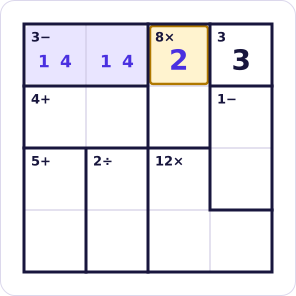
In a 4×4 grid, a 3− cage sits across the first two squares of the top row. It must hold 1 and 4. The other two squares of that row must then hold 2 and 3. If the last square of the row is also a one-square cage showing 3, the third square is 2, and you have filled half a row before doing any real arithmetic.
Use the row and column totals
Every row and every column holds each digit once, so each one adds up to the same total: 10 in a 4×4 grid, 15 in a 5×5 grid and 21 in a 6×6 grid. This is the most useful trick in the puzzle.
When a row is covered entirely by addition cages and one leftover square, add up the cage targets and subtract them from the row total: the difference is the leftover digit. The same works for a column, and for two rows together (twice the total) when cages stick out of one row into the next. Cages that are not addition cages still help when you have narrowed them down to a single digit set, because then you know their sum too.
Advertisement
Notes and elimination
On medium and hard days most of the solving happens in the notes. A good routine:
- List the digit sets for each cage. For a two-square cage this is quick. For a three-square sum, list the combinations that reach the target with no repeat in the same row or column.
- Note the candidates. Switch on Notes and add the possible digits to each square of the cage.
- Cross out what the rows and columns already have. Every digit you place removes itself from the notes in its row and column (the page can do this for you: leave Notes clear themselves switched on).
- Look for a lonely candidate. A square with one note left is solved, and a digit that can only go in one square of a row or column belongs there.
Repeat until the grid is full. When it stalls, return to the row totals or look at a cage whose digit sets you have not written down yet.
Bent cages and repeated digits
A cage that turns a corner, such as an L of three squares, can hold the same digit twice, as long as the two copies are in different rows and different columns. This surprises many players: 1+1+2 = 4+ is a perfectly good L-shaped cage, and so is 2×2×3 = 12×. Straight cages along a row or column can never repeat a digit. Keep this in mind when you list digit sets, or you will rule out the right answer.
Speed habits
- Fill one-answer cages first, then the row totals. These two steps alone often solve an easy grid.
- Prefer pairs over guesses. Two digits locked in a cage are almost as useful as a placed digit; note them and move on.
- Watch the red marks. With Show mistakes on, a digit repeated in a row or column is underlined in red, and a full cage that misses its target is tinted, so a slip never costs you the whole grid.
- Use the keyboard on a computer. Arrow keys move, digits fill, N switches notes, Backspace erases and Ctrl+Z undoes.
Scoring and the leaderboard
Calcudoku is ranked by time, fastest first; fewer entries break ties. The clock starts with your first move, the grid is checked the moment the last square is filled correctly, and only a member's first solve of the day counts for the leaderboard. Practice puzzles from Play more are never ranked, so they are a good place to try the techniques above at your own pace.
Play it now
Every game is free in your browser, with nothing to download; the daily puzzles change at midnight and the archive keeps the last 60 days. See all the number games.
Questions and answers
Can a digit repeat inside a cage?
Yes, when the two squares are in different rows and columns, which can happen in a cage that bends. A digit never repeats in a row or a column.
Why do minus and divide cages have only two squares?
Because subtraction and division depend on order. With two squares the rule is simple: the bigger digit minus, or divided by, the smaller one.
Does every puzzle have one solution?
Yes. Each grid is checked by a solver when it is made, and only grids with exactly one answer are published, so logic alone always gets you there.
How is it ranked?
By time, fastest first; fewer entries break ties. Only a member’s first solve of the day counts.
Written by the DailyGameClub team from the rules as DailyGameClub plays them. Updated October 26, 2026. New to a word? See the glossary. Spotted a mistake? Tell us.