How to Solve Kakuro: Cross Sum Strategy
How to solve Kakuro cross sums without guessing: reading the clues, the runs that can only be made one way, crossing runs, and a routine for hard grids.
Kakuro looks like a crossword that someone filled with numbers. The grid has black squares and white squares. Every black square that starts a run carries a clue: the number in its top right corner is the total of the white run to its right, and the number in its bottom left corner is the total of the run below it. Your job is to write a digit from 1 to 9 in every white square so that each run adds up to its clue, and no digit appears twice in the same run. Across and down work at the same time, so every white square belongs to two runs and has to satisfy both.
The arithmetic never gets harder than adding a handful of small numbers. What makes Kakuro satisfying is the logic: totals that can only be built one way, crossings that leave a single digit, and the slow chain reaction as one square fixes the next. Every daily grid on this site has exactly one solution and can be solved without guessing.
Reading the grid
Before writing anything, take a moment to look at the shape of the puzzle.
- Run length. Count the white squares in a run. A run of two needs two different digits, a run of three needs three, and so on up to nine.
- The range of a total. The smallest total a run of length n can have is 1 + 2 + ... + n, and the largest is 9 + 8 + ... down n digits. A run of two adds up to between 3 and 17, a run of three to between 6 and 24, a run of four to between 10 and 30.
- Totals near the ends of the range are gifts. The closer a clue is to its minimum or maximum, the fewer ways there are to make it.
The runs that can only be made one way
These are the starting points of almost every solve. Learn them and you will see them everywhere.
| Squares | Total | Digits |
|---|---|---|
| 2 | 3 | 1, 2 |
| 2 | 4 | 1, 3 |
| 2 | 16 | 7, 9 |
| 2 | 17 | 8, 9 |
| 3 | 6 | 1, 2, 3 |
| 3 | 7 | 1, 2, 4 |
| 3 | 23 | 6, 8, 9 |
| 3 | 24 | 7, 8, 9 |
| 4 | 10 | 1, 2, 3, 4 |
| 4 | 11 | 1, 2, 3, 5 |
| 4 | 29 | 5, 7, 8, 9 |
| 4 | 30 | 6, 7, 8, 9 |
The table tells you which digits are in the run, not where they go. A two square run of 3 is either 1 then 2 or 2 then 1. To decide the order, look at the other run through each square.
Some totals are not unique but still very useful. A run of two adding up to 5 is 1 and 4 or 2 and 3, so it can never hold 5 or anything above. A run of three adding up to 8 is 1, 2, 5 or 1, 3, 4, so it must contain a 1.
Where runs cross
Every white square sits where an across run meets a down run. Its digit must be allowed by both, and that is where most deductions happen.
- Write down what each run allows. Use the notes mode for this, or switch on the possible digits helper in Options, which lists the digit sets for both runs of the selected square.
- Keep only the digits in both lists. If the across run is 17 in two (8 and 9) and the down run is 4 in two (1 and 3), the square has no common digit, which tells you that you have misread something. In a real puzzle the overlap is never empty, and it is often a single digit.
- Place it, then look at its neighbours. A placed digit shrinks the choices of both runs through it. Follow the effect along each run before moving on.
A corner that solves itself
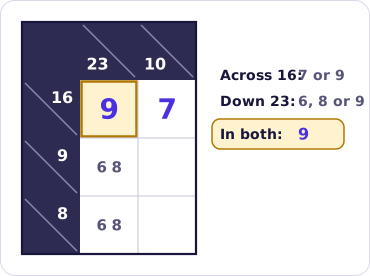
Picture a white square at the top left of a block. Its across run is 16 in two squares, so it holds 7 or 9. Its down run is 23 in three squares, so it holds 6, 8 or 9. The only digit in both lists is 9. The square is a 9, its across partner is a 7, and the rest of the down run is 6 and 8 in some order, which the next crossings settle.
Advertisement
Working a run with digits already placed
Once a run has some digits in it, subtract them from the total and solve the smaller problem that is left.
- One square left. The last square of a run is simply the total minus the digits already there. If that number is already used in the run, or is outside 1 to 9, an earlier digit is wrong.
- Two squares left. Subtract the placed digits, then ask which pairs of unused digits make the remainder. Often there is only one pair, or only one pair that fits the crossing runs.
- Digits that must be somewhere. If every way to make a run uses a certain digit, that digit is in the run. When only one open square of the run can take it, it goes there.
The last idea is the Kakuro version of a hidden single in sudoku. It is surprisingly powerful on long runs: a run of four adding up to 12 can be made as 1, 2, 3, 6 or 1, 2, 4, 5, so it always contains 1 and 2, and if only two squares of it can hold small digits, those squares are settled as a pair.
A routine for hard grids
The 10 × 10 grids on hard days take longer, but the same steps get you there.
- Sweep for unique runs. Go across the whole grid and note every run from the table above.
- Settle every crossing between two unique runs. These usually give your first digits.
- Use the edges of the range. A run that can never hold a 9, or must hold a 1, often decides a crossing even when the run itself has several combinations.
- Subtract and repeat. After each placement, recompute what the two runs through it still need.
- Check sums as you go. With Flag mistakes on in Options, a repeated digit or a full run with the wrong total is shown at once, so an error never spreads.
If you get stuck, pick the run with the fewest possible sets and look at every square in it against its crossing run. One of them almost always gives way.
Difficulty, scoring and the leaderboard
| Level | Grid | White squares |
|---|---|---|
| Easy | 6 × 6 | about 15 to 21 |
| Medium | 8 × 8 | about 27 to 39 |
| Hard | 10 × 10 | about 42 to 59 |
The first row and the first column of every grid are clue squares. Kakuro is ranked by time, fastest first; the number of digits you entered breaks ties. Undo takes back your last change, notes never count as entries, and only a member's first solve of the day goes on the leaderboard. If you enjoy the arithmetic side, the other number games are a good next stop, and the sudoku guide shares many of the same habits.
Play it now
Every game is free in your browser, with nothing to download; the daily puzzles change at midnight and the archive keeps the last 60 days. See all the number games.
Questions and answers
What is the difference between Kakuro and sudoku?
Both place the digits 1 to 9 without repeats, but Kakuro has no fixed boxes: each run has its own total to reach, so the clues are sums instead of given digits.
Can the same digit appear twice in a row?
Yes, if a black square separates the two runs. The rule only forbids a repeat inside one run.
Is guessing ever needed?
No. Every daily grid is checked by a solver that uses logic only, so each square can be worked out from the clues.
What does the possible digits helper show?
For the selected square it lists every set of digits that makes its across total and its down total, leaving out sets that clash with digits already placed.
How is it ranked?
By time, fastest first; fewer digits entered break ties. Only a member’s first solve of the day is ranked.
Written by the DailyGameClub team from the rules as DailyGameClub plays them. Updated October 26, 2026. New to a word? See the glossary. Spotted a mistake? Tell us.