How to Solve Tents and Trees Puzzles
How Tents & Trees works and how to solve it: zero lines, grass round every tent, full rows, lonely trees and the patterns that place tents fast.
Tents & Trees is a logic puzzle set on a little campsite. The field is a square grid with trees on some squares, and every tree needs a tent. Your job is to place the tents so that four rules all hold at once:
- Every tree gets one tent of its own, in a square directly above, below, left or right of it. Diagonal squares do not count for this.
- There are exactly as many tents as trees, and they pair up one to one.
- Tents never touch, not across, not down and not even at a corner.
- The numbers count the tents. The number at the start of each row and column says how many tents that line holds.
Squares that cannot hold a tent are grass. Marking them is optional, but it is the heart of solving: the field slowly fills with grass until each remaining tent has only one place to go.
Controls on the page
Tap a square once for a tent, a second time to mark it as grass, and a third time to clear it (an option swaps the order to grass first). Long press or right click marks grass straight away, and dragging across several squares paints grass along the way. When a row or column already has all its tents, tap its number: the rest of that line is filled with grass for you. On a computer the arrow keys move, Space changes a square, T places a tent and G marks grass.
Sizes and difficulty
| Level | Field | Trees |
|---|---|---|
| Easy | 6 × 6 | 7 or 8 |
| Medium | 8 × 8 | 12 to 14 |
| Hard | 10 × 10 | 18 to 21 |
Every daily field is solved by a program using only the rules below before it is published, so it has one answer and never needs a guess.
First sweep: free grass
Before placing a single tent, mark the squares that can never hold one:
- Rows and columns marked 0. Every square in them is grass.
- Squares with no tree beside them. A tent must touch its tree across or down, so a square with no tree in any of its four neighbours is grass.
On an easy field this first sweep often turns half the board pale, and the first tents become obvious.
Grass round every tent
Each tent you place makes its eight neighbours grass, because tents never touch. Mark them at once, or switch on Grass round tents in the options to see them shaded automatically. Many players forget the diagonal squares; those are often the ones that decide the next tent.
Counting the lines
The numbers do most of the work once the free grass is marked:
- Full lines. A row with as many tents as its number is finished: the rest of it is grass. Tap the number to fill it.
- Exact fits. A row that needs two more tents and has exactly two open squares left must take a tent in both, as long as they are not side by side.
- Stretches. Open squares in a row that sit side by side can hold at most every other square. A stretch of three can hold two tents only as tent, grass, tent. When the stretches in a line can only just hold the tents it needs, every odd stretch is filled that way.
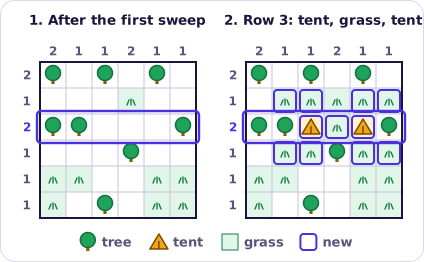
A stretch of three
A row of a 6 × 6 field needs two tents, and after the first sweep only three neighbouring squares are still open: the third, fourth and fifth. Two tents in three squares with no two touching must go in the third and fifth squares, and the fourth is grass. The two squares above and below each new tent, and the corners, become grass too.
Advertisement
Trees with one choice
A tree whose four neighbours are all grass, trees or the edge, except one, has found its tent. This happens often near the walls and in crowded corners. Remember that the tent must belong to that tree: two trees side by side cannot share one tent, so when two trees are left with the same two open squares, each takes one of them.
Pairs and corners
As the field closes in, look at small groups of trees together. Two trees in a row with one square between them, both still without tents, often settle each other: if the middle square takes one tree's tent, the other tree must use a different side, and that side may be the only one left. Corners are similar. A tree in a corner has only two neighbours, and if one is grass the other is its tent.
Common mistakes
- Diagonal tents. A tent diagonally next to its tree does not count; it must share a side.
- Two tents for one tree. The numbers might allow it, but there are exactly as many tents as trees, so every tree gets one.
- Touching corners. Show mistakes rings tents that touch in red, so you notice at once.
Scoring and the leaderboard
Tents & Trees is ranked by time, fastest first; fewer changes break ties. Grass marks are your own notes and never checked, but every tap counts as a change, so marking only the grass you need is a little faster. The field is checked the moment the tents are right, and only a member's first solve of the day is ranked. If you like reasoning about where things can and cannot go, try Bridges and Daily Mines next.
Play it now
Every game is free in your browser, with nothing to download; the daily puzzles change at midnight and the archive keeps the last 60 days. See all the logic games.
Questions and answers
Can one tent serve two trees?
No. There are as many tents as trees and they pair up one to one, so every tree has a tent of its own beside it.
Can a tent be next to a tree that is not its own?
Yes. A tent may touch several trees; it only has to be paired with one of them, and every other tree needs its own tent elsewhere.
Do I have to mark the grass?
No. Grass marks are notes for you and are never checked. The puzzle is solved as soon as the tents are in the right squares.
What do the dots on some squares mean?
A few fields show a tent or a grass square from the start. They are part of the puzzle and cannot be changed.
Written by the DailyGameClub team from the rules as DailyGameClub plays them. Updated October 26, 2026. New to a word? See the glossary. Spotted a mistake? Tell us.